Law 6: Court Attention at All Costs — Meaning, Examples & How to Apply It
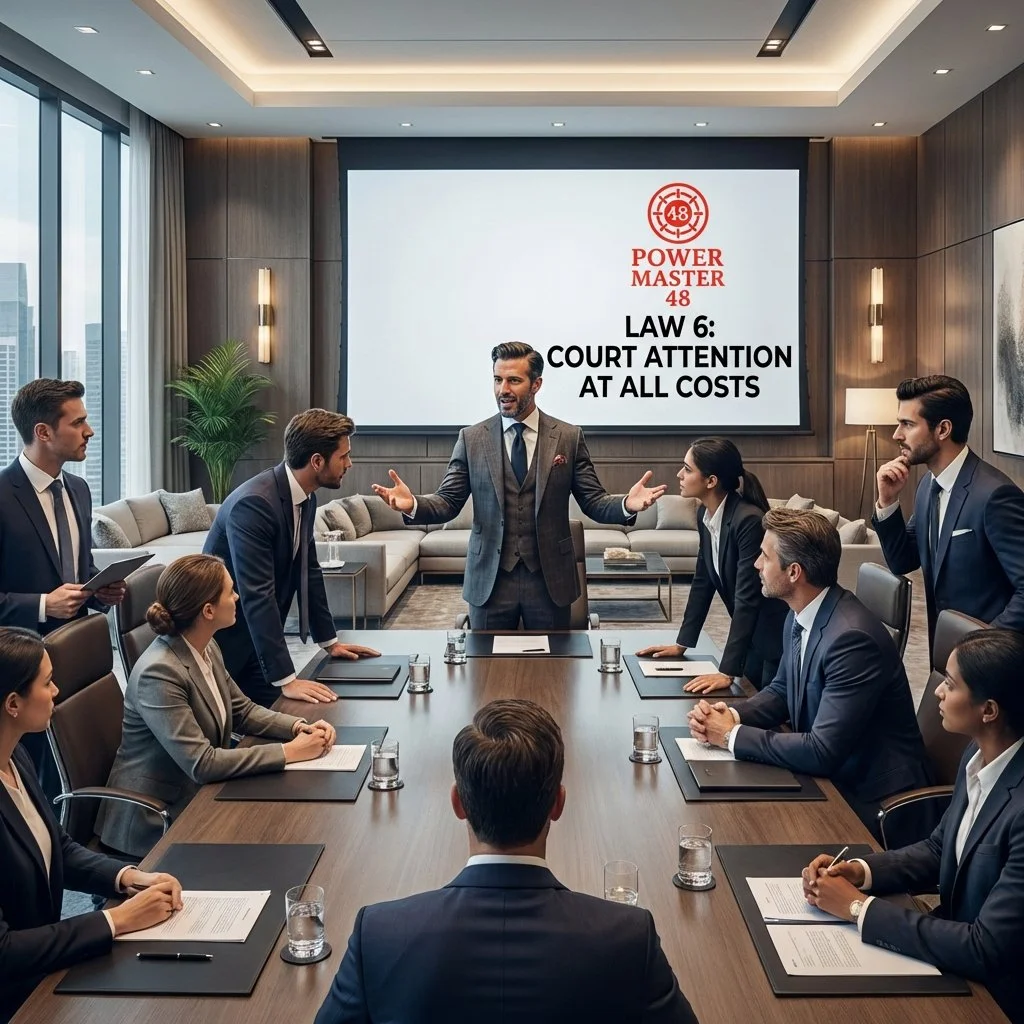
Law 6 in action: be seen, be remembered, be chosen.
Be seen. Be remembered. Be chosen.
Talent without visibility is easy to ignore.
You can be the smartest person in the room, do exceptional work, and have better ideas than everyone around you. But if nobody notices, remembers, or talks about what you do, someone more visible can take the opportunity instead.
That is the uncomfortable reality behind Law 6: Court Attention at All Costs.
What Does “Court Attention at All Costs” Mean?
Court Attention at All Costs means making yourself visible and memorable instead of allowing your value to go unnoticed.
Attention creates recognition. Recognition creates influence. And influence creates opportunities.
The point is not to become loud, obnoxious, or desperate for attention.
The deeper lesson is simpler:
If people don’t notice you, they cannot choose you.
In work, business, leadership, and social situations, being ignored can sometimes be more damaging than being criticized.
Why Attention Creates Power
Attention determines what people perceive as important.
Think about two equally capable people.
One does excellent work quietly and assumes the results will speak for themselves.
The other does excellent work—but also knows how to present it, communicate its impact, and make people remember who produced the result.
Who gets remembered when an opportunity appears?
Usually the second person.
This is why attention can affect:
who gets invited into important conversations
who receives opportunities
who gets promoted
whose ideas spread
who attracts customers or followers
who becomes associated with success
who is remembered when decisions are made
Attention is not the same as power.
But attention is often the gateway to power.
The Biggest Mistake: Assuming Good Work Speaks for Itself
Many talented people believe:
“If I’m good enough, eventually people will notice.”
Sometimes they will.
Often they won’t.
Managers have limited attention. Audiences have limited attention. Customers have limited attention.
Everyone is surrounded by competing signals.
If you remain invisible while someone else consistently communicates their value, the other person may become associated with competence—even when your actual work is stronger.
Quiet competence is valuable.
Invisible competence is vulnerable.
What Law 6 Does NOT Mean
“Court Attention at All Costs” sounds extreme when taken literally.
It can easily be misread as:
create drama
provoke people constantly
brag about everything
manufacture controversy
interrupt others
become the loudest person in every room
Those tactics can attract attention.
They can also destroy trust.
The stronger interpretation of Law 6 is:
Become visible for something worth remembering.
You don’t need everyone’s attention.
You need the right attention, from the right people, at the right moment.
Law 6 Examples in Real Life
Example 1: At Work
Two employees contribute heavily to a successful project.
The first finishes the work and moves immediately to the next task.
The second finishes the work and clearly communicates:
what problem was solved
what changed
what measurable result was achieved
what should happen next
The second employee isn’t necessarily more talented.
But their contribution is easier for management to see, understand, and remember.
That’s Law 6 in practice.
Example 2: In Business
Two companies sell comparable products.
One explains features.
The other develops a distinctive identity, memorable positioning, recognizable visuals, and a clear story people repeat.
The second company occupies more mental space.
When customers eventually need the product, which company comes to mind first?
Attention has become commercial leverage.
Example 3: In Leadership
A leader who speaks constantly can become background noise.
A leader who chooses their moments carefully can command far more attention.
They stay quiet while others debate.
Then, when the room needs direction, they make the decisive point.
Everyone remembers it.
Law 6 isn’t necessarily about more attention.
Sometimes it is about concentrating attention into the moments that matter.
How to Apply Law 6 Without Looking Desperate for Attention
1. Decide What You Want to Be Known For
People rarely remember twenty things about someone.
They remember one or two.
Choose your edge.
Perhaps you’re:
the person who simplifies complexity
the person who stays calm under pressure
the person who gets difficult projects finished
the person with unconventional ideas
the person who sees opportunities others miss
Then reinforce that association consistently.
Don’t try to be memorable for everything.
Own something.
2. Make Results Visible
Don’t assume people understand the value of what you’ve done.
Communicate outcomes.
Instead of:
“I’ve been working on this for three weeks.”
Say:
“This reduced the process from three days to four hours.”
Effort describes what you did.
Impact tells people why they should remember it.
3. Create Memorable Moments
Attention concentrates around events.
A strong presentation.
A successful launch.
A surprising result.
A decisive intervention when everyone else is hesitating.
A compelling demonstration.
You don’t need to perform constantly.
Create moments people can attach your name to.
4. Use Contrast
The brain notices differences.
If everyone approaches a problem one way, showing a credible alternative creates attention naturally.
For example:
“Everyone is trying to make this faster. The real problem isn’t speed—it’s how often we’re forced to redo it.”
You haven’t shouted.
You haven’t bragged.
You’ve introduced a distinction people can remember.
5. Make Your Ideas Easy to Repeat
The strongest attention is attention other people create for you.
Give people something simple enough to repeat:
a clear idea
a memorable phrase
a strong result
a distinctive concept
a compelling story
If someone can explain your value to another person in one sentence, your reputation can travel without you.
The Psychology Behind Law 6
Human attention is limited.
We therefore use shortcuts to decide what deserves importance.
What is repeated feels important.
What is distinctive becomes memorable.
What creates emotion receives attention.
What everyone discusses begins to feel significant.
This creates an important power dynamic:
Visibility can amplify perceived importance.
Once people begin paying attention to someone, other people notice that attention.
They start wondering:
Why is everyone watching this person?
Attention can therefore compound.
But the reverse is also true.
If nobody notices you, people may assume there is nothing to notice.
That is why strategic visibility matters.
The Dangerous Side of Law 6
Attention is powerful precisely because it is seductive.
Once people discover that controversy produces attention, they can begin optimizing for attention rather than value.
That leads to:
manufactured outrage
constant self-promotion
unnecessary conflict
increasingly extreme behavior
attention without credibility
Eventually, the person becomes famous for being visible rather than valuable.
That’s a weak position.
Attention without substance makes you a spectacle.
Substance without attention makes you invisible.
The stronger position combines both.
When Law 6 Can Backfire
Not every situation rewards visibility.
Sometimes attracting attention too early exposes:
unfinished plans
vulnerabilities
ambitions
mistakes
capabilities that threaten someone above you
This is where the Laws interact.
Law 1 — Never Outshine the Master reminds you that visibility can become dangerous when your success makes someone above you feel threatened.
Law 3 — Conceal Your Intentions reminds you that attention can expose plans and ambitions before the right moment.
Law 4 — Always Say Less Than Necessary shows why visibility does not require constantly speaking or revealing everything you know.
Law 6 tells you to understand the value of attention. It does not tell you that maximum visibility is always optimal.
It does not tell you that maximum visibility is always optimal.
Sometimes you should court attention.
Sometimes you should deliberately disappear.
The real skill is knowing the difference.
Law 6 in One Sentence
Court Attention at All Costs means refusing to let your value become invisible: create strategic visibility, become memorable, and make sure the right people recognize what you bring to the table.
You don’t have to be the loudest person in the room.
You have to be someone the room remembers.
Train Law 6 Until It Becomes Instinct
Understanding Law 6 while reading it is easy.
Recognizing the right move when you’re actually in the room is harder.
Should you speak—or stay silent?
Take the spotlight—or let someone else have it?
Reveal the result—or wait for a stronger moment?
Create attention—or deliberately avoid it?
That’s why Power Master 48 is built around practice.
Instead of passively reading the Laws of Power, you train with realistic scenarios that force you to choose what you would actually do—then learn the strategy behind the stronger move.
Train the Laws of Power until they become instinct.
Final thought
Being good is not enough if nobody knows you’re good.
Being valuable is not enough if nobody remembers your value.
And being powerful is difficult when nobody is paying attention.
Don’t chase attention simply to be seen.
Give people something worth seeing.
Then make sure they remember who showed it to them.